
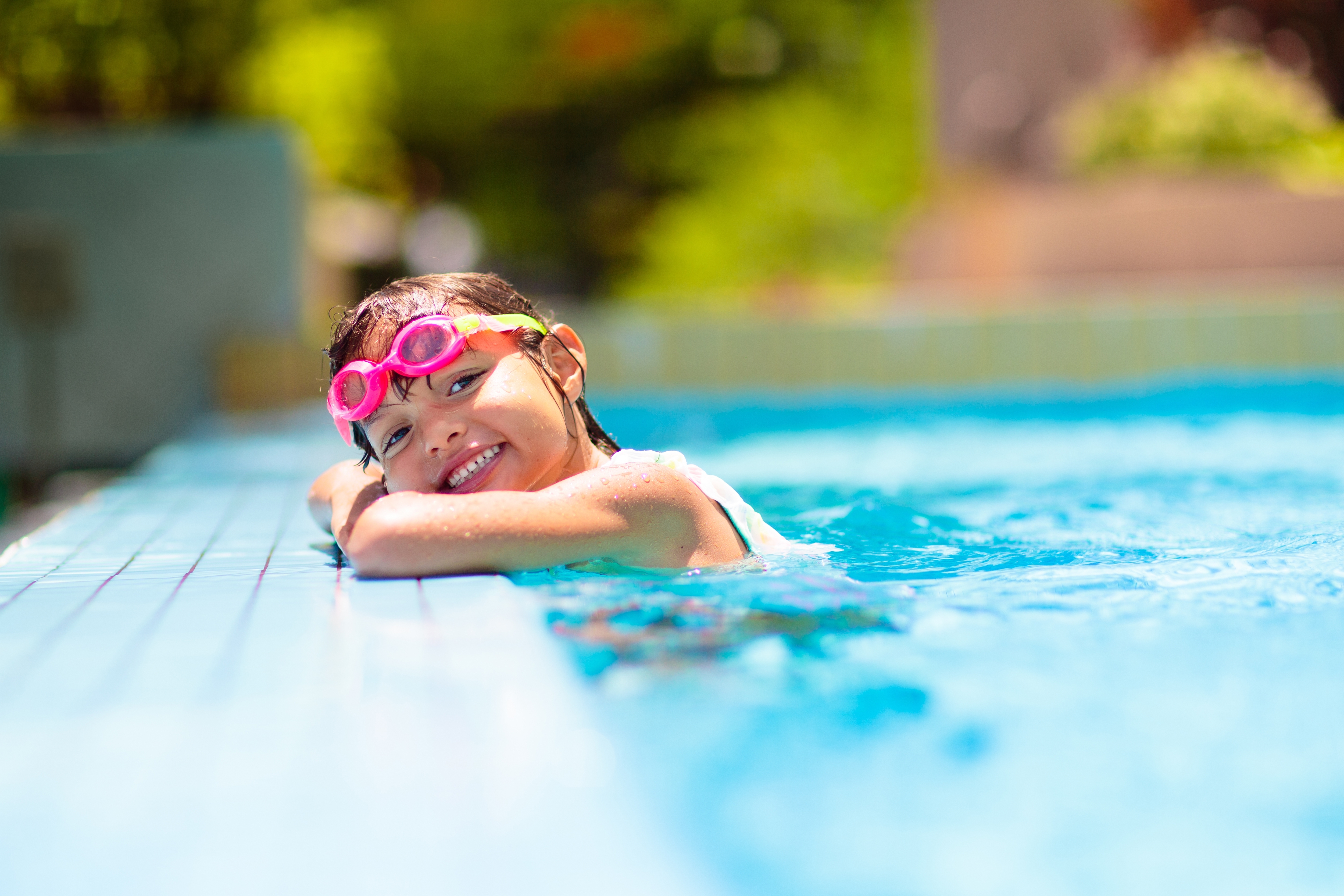
We’ve been doing weekly swimming lessons with Rackley Swimming at one of our local pools, and honestly, Miss A is thriving.
We haven’t been as consistent as we’d like — life happens, and our latest curveball was an ear infection that left her with a small perforation in her eardrum.
Ouch. Poor little thing! But she’s been such a trooper through it all.
And each time we do make it to the pool, we see her confidence grow and her love of the water, *cough* … deepen?! Hmm. :-p
Teaching Miss A to swim — and to enjoy the water — is something J and I feel really strongly about.
It’s more than just a fun activity – it’s a life skill that could one day save her life.
And who knows … Olympics here we come?! (Ha. Kidding … Mostly.)
But seriously, it’s had me thinking a lot about the importance of early swim exposure — especially for busy parents navigating rising costs and packed schedules.
How can we build water familiarity from a young age, even if weekly lessons aren’t always realistic?
To explore this further, I spoke with Emma Lawrence, daughter of Olympic swimming coach Laurie Lawrence and manager of the Kids Alive Do the Five program, for her expert advice and practical tips on getting little ones started with swimming early.
‘learning to swim early does save lives’
“From a drowning prevention perspective, learning to swim does save lives,” says Emma, pointing out that there are a lot of other benefits that come from learning to swim.
These include not just physical benefits, but also social and emotional – so, mental health – benefits as well.
“All of these things are going to benefit little children under the age of 5,” she says.
“We can all probably look back on our childhood and think about the fun times we’ve had around the water.
“Whether it’s going to the beach or having picnics down near the creek or swimming in your backyard pool – whatever it is, we grow up around the water.”
And while learning to swim doesn’t make you “drown proof”, Emma says that it teaches you to develop a healthy respect for the water.
“No one is drown proof,” says Emma, “but we learn a respect for the water and we learn different water safety messages from starting swim lessons from a very early age.
“So, it does save lives.”
‘swimming lessons do make a difference’
In terms of the other benefits swimming lessons provide from a developmental perspective, pointing to research by Professor Robyn Jorgensen, Emma says swimming has many benefits outside of just the physical benefits.
“Professor Robyn Jorgensen did a longitudinal study on the benefits of early years swimming, and she actually recorded that children who learn to swim from an early age were up to 10 months ahead of their peers by the time they started school,” says Emma.
“So, there is actually strong evidence to show that it’s not just the swimming teachers saying how great swimming is, but it is actually making a difference.
“Because when children go to swimming lessons, they’re learning things like counting, how to problem solve, how to negotiate with others, how to follow instructions – there’s a whole range of things that are happening.”
Emma also highlights the social benefits of swim lessons – including as a social outlet for parents.
“Mums and dads are able to meet new friends […] so they don’t have that feeling of isolation,” she says, adding that swim schools are very inclusive from the social aspect.
“It’s a great way to make community connections and friends,” adds Emma.
‘it’s never too late to learn to swim’
Speaking about the best age to start swim lessons or to introduce baby to the water, Emma says her key message to parents is that “it’s never too late to learn to swim”.
“I don’t want parents to feel any guilt if they haven’t started their baby [in swimming lessons] from a really early age,” she says.
Rather than focusing on starting age, the key instead, says Emma, is “regular exposure to the water”.
“The more you take your child to the pool, the better they will get,” she says.
However, interestingly, Emma points out that introducing baby to the water earlier is easier compared with waiting until they’re a little older.
“If you introduce your baby to the water – so, say, a 4-6-month-old baby – they are easier to introduce to the water then, say, a 2-year-old child,” she says.
The reason here, as Emma explains, is that the older a child becomes they are more “aware their situation and they have [more] fears”.
“So, it can be more challenging to teach say, a 2-year-old to swim, than it can be to start a little baby,” she says.
“But it’s never too late. Regular exposure is key when learning to swim.”
taking cost-of-living into account
With rising costs-of-living it can be tough to justify swimming lessons in the monthly budget, when there’s additional pressure to make ends meet and, well, to merely put food on the table.
Swimming lessons can almost feel like a privileged luxury at times!
And Emma gets this!
“I know a lot of parents [who] are doing swimming lessons on a budget,” she says.
“In fact, I say to friends who are doing it tough, do your formal swimming lessons during the winter months and then in summer give your children regular play activities.”
These play activities include time spent at the beach, the local creek or even friends’ pools.
“That way you can swim all-year-round, and the level of child’s swimming ability will be really good because they’re swimming all-year-round,” says Emma.
“If you can’t commit to year-round swimming lessons, which is ideal, certainly start in winter if you’ve got access to a heated pool.”
‘learning through play and exploration’
While, as Emma says, children learn a lot through formal swimming lessons, they also learn a lot through informal play in the water.
“They will learn through play and exploration,” she says.
“So, if you can take them for regular opportunities at friends’ pools or down to your local public pool or swim between the flags at the beach, obviously they’re going to get some great outcomes just through your play and exploration.”
do kids need flotation devices when learning to swim?
In terms of equipment, it can get really overwhelming as a parent in terms of knowing what your child will/will not need when they’re learning to swim.
And equally, as parents we can get a little over excited at times and go out and buy things that we, perhaps, don’t really need.
“I don’t recommend using floatation devices when learning to swim,” says Emma.
“Because floating is the basis of all ‘learn to swim’. So, learning your own buoyancy is essential.
“If children are wearing floatation devices, a lot of the time they lose that ability to independently float.
“And they struggle, and use their arms and legs really vigorously to keep themselves afloat.
“So, floating is a basis of all learn to swim.”
Emma adds that the exception here is, “of course, when you’re taking your kids out on a boat or out kayaking”.
“You would put a life-jacket on them for them to be safe in that sort of context.
“But for swimming, I would not encourage floatation devices,” she says.
In terms of equipment like goggles for swimming, Emma says this need arises once children learn to swim and are going under water – this is when they will need goggles, for example.
“Even us, as adults, we wouldn’t go for a swim for half an hour without goggles – our eyes would start to get sore,” she points out.
“The rule of them there,” Emma adds, “is you don’t want children to become reliant on goggles. So, you would always spend some time without the goggles during a lesson.”
When it comes to the learn to swim environment, Emma reiterates that’s it’s all about ‘less is more’ in terms of the swim equipment that’s recommended.
“The water is the toy – the water is play,” she says.
“You don’t need a whole lot of equipment, because you should be making the most of the actual water itself.”
Emma adds that “diving toys are always fun” – and certainly they make the most of the water – and recommends that kickboards could be used for kicking, but certainly, “children under the age of 5 aren’t needing [things like] flippers or anything like that”.
‘you’ll never regret teaching your child to swim’
“Any time is a great time to teach a child to swim,” says Emma.
“There’s got to be a lot of consideration for each individual family as to when they can start their kids [with swimming] […] but I think the big thing is, you will never regret teaching your child to swim.
“You open up so many fantastic opportunities and memories for your family [through swimming],” she says.
Plus, Emma reiterates, particularly for parents who may be hesitant to put their kids in swimming lessons: “It’s a skill that could save your child’s life.”
“If you can only choose one activity to take your child to, for me, it would be choosing swimming,” she says.
learning CPR through the month of May
As part of her work at their swim school, which is located on the Gold Coast in Queensland, Emma also runs their drowning prevention campaign, which is the Kids Alive Do the Five program.
“[This] is an education campaign for parents and it pushes those key messages of pool fencing, supervision, learning CPR,” explains Emma.
“And actually, at the moment, throughout the month of May, we’ve got a free program offering CPR to parents right across Australia,” she says.
The CPR training is online training that parents can access via: Heart Beat Club.
“It takes about an hour and you can go through and learn all about CPR and first aid,” says Emma.
Miss A’s growing confidence in the water is certainly testament to just how valuable early swim exposure can be.
Whether through formal swim lessons or simple water play, building water familiarity is a gift that supports safety, development, and fun!
And, as Emma says, “you’ll never regret teaching your child to swim” – we certainly haven’t.
xo G.

editor, journalist, digital content creator with a background in nutrition & dietetics.
Leave a Reply